
Paper Carpenter was established with a mission to become the go-to-destination for innovative and sustainable cardboard designs. We wanted to be a company that, more than anything else, promoted the use of eco-friendly materials to mitigate environmental impact. Promoting these values, however, means walking the talk. As such, our materials needed to be specially sourced and produced to meet our rigorous standards.
Many clients have asked, “How is Paper Carpenter cardboard sourced and recycled?” So today, we wanted to share a peek behind the scenes for others who might have a similar line of query.
Sourcing
To perpetuate a cycle of eco-conscious consumption, one of the most important things we had to settle on, at the start, was sourcing. All our cardboard materials had to be acquired from sustainable sources.
We settled on FSC certified sources, chiefly because they emphasise, among other things, protection of biodiversity and habitats, respect for indigenous people’s rights, and sustainable forestry practices that prevent deforestation.
Using this cardboard for our iconic design innovations, ensures that we, and our clients, reduce environmental impact.
Shred and Pulp
Once a cardboard product has outlived its use, our partners collect and transport the used cardboard to a recycling facility where it is shredded into small pieces.
The shredded cardboard is then mixed with water and chemicals in an industrial machine called a pulper that agitates the mixture to loosen and release fibres in the cardboard, forming a slurry (a mixture of water and dissolved paper pulp)
Filtering and Cleaning
The slurry is then pumped through a number of machines, where it passes through screens to remove foreign particles and contaminants. What is left after this filtering process is cleaned and thickened until it reaches the right consistency.
Getting the right consistency is important because it directly impacts the quality of the cardboard. A well-balanced slurry ensures that cardboard has the desired thickness, strength and durability.
Paper Formation
The cleaned slurry is then pumped into a paper machine that converts it into a long sheet of paper. It’s worth noting that at this stage, the mixture is still 99% water. This diluted mixture is sprayed onto a wire mesh belt, with very tiny holes in it, to provide a thick, consistent layer of pulp across the machine belt.
The water thereafter is drained away, through holes in the belt leaving a mat of intertwined fibres.
Drying and Pressing
What’s left after the water is drained away, passes into a drying section. Heat and pressure are used to remove the water and dry the paper; this is achieved through a series of steam heated pressure rollers.
As the sheet rolls out of the machine, after checks for thickness and quality are conducted, it is wound onto a large roll, also known as a jumbo reel. What’s left is to split the sheet into specific lengths.
Final Thoughts
Cardboard offers a host of benefits: it’s versatile, lightweight, biodegradable, affordable, suitable for many applications, and, more importantly for the environment, its manufacture means a reduction of up to 60% in CO2 and oil emissions compared to other materials.
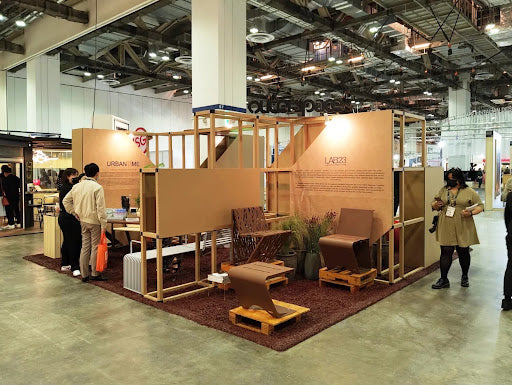
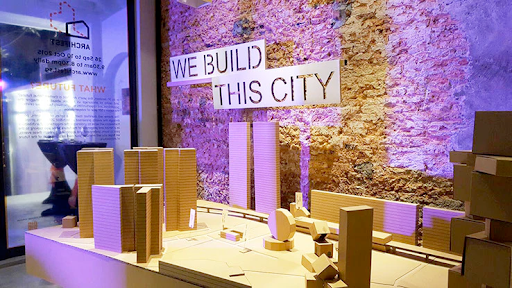
Using cardboard has allowed us to achieve many design feats both in function and form. Whether it’s a backdrop, or exhibition booth, we can help. Contact us today and let us help make your event a sustainable success.
Frequently Asked Questions
Is Paper Carpenter cardboard made from recycled materials?
Yes. Our cardboard is sourced from FSC-certified suppliers and can be recycled after use. Once collected, it undergoes shredding, pulping, filtering, and reforming to create new sheets. This approach supports responsible material use and reduces reliance on virgin resources.
What does FSC certification mean?
FSC (Forest Stewardship Council) certification ensures that wood-based materials are sourced from responsibly managed forests. This includes protecting biodiversity, preventing illegal logging, respecting indigenous communities, and maintaining long-term forest sustainability.
How many times can cardboard be recycled?
Cardboard fibres can typically be recycled five to seven times before they become too short for reuse. Advances in recycling technology help maximise fibre recovery, allowing cardboard to remain within the circular economy for multiple cycles.
What happens to cardboard after it is collected for recycling?
After collection, cardboard is shredded and mixed with water in a pulper to release its fibres. The resulting slurry is filtered to remove contaminants, then pressed and dried into new sheets. These sheets are rolled, cut, and reused in various applications, including new cardboard products.
Does recycling cardboard reduce carbon emissions?
Yes. Recycling cardboard reduces the need for raw timber harvesting and lowers the energy required in manufacturing. Compared to producing certain alternative materials, cardboard manufacturing can reduce CO₂ and oil-related emissions significantly, making it a more environmentally conscious option.
Is cardboard suitable for long-term use?
While biodegradable, high-quality cardboard is engineered for durability. When properly treated and designed, it can be used for exhibition booths, furniture, and structural applications. After its useful life, it can be recycled, completing the sustainability cycle.